
- SUBLIMATION OVERVIEW
- A-Z ALPHABETICAL LISTING
- WASTE INK TRAYS


- HTV BY THE METRE
- HTV CAMEO/CRICUT STRIPS
- HTV PORTRAIT STRIPS
- SIGN VINYL


- LOOSE RHINESTONES & STUDS


- RHINESTONE & RHINESTUD ALPHABETS

- INKJET PAPER DARK FABRICS
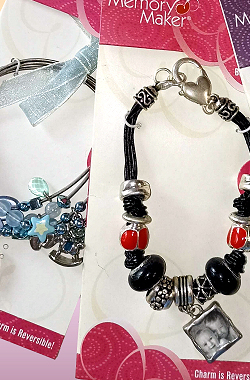
- MEMORY MAKER JEWELLERY
- SPECIAL OFFERS
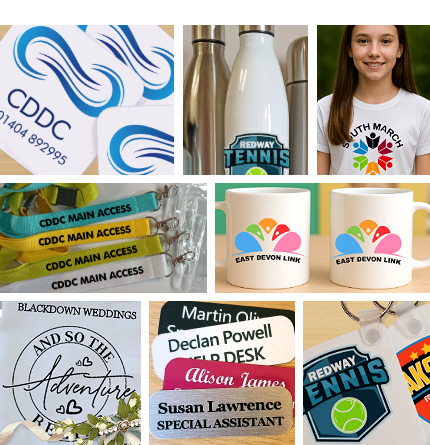
 THE GIFT FACTORY THE GIFT FACTORYThe Gift Factory was originally created for retailers in the giftware and greetings card industries who wanted to create personalised merchandise "on demand” for their customers. Recently we’ve seen increasing interest from companies and organisations in a wide range of other sectors keen to take advantage of these extremely straightforward processes to enhance their own merchandise for their customers, members and supporters thus creating additional revenue streams and also to create products used within the organisation such as signage, badges and staff uniforms. We’re now developing a range of systems and packages for specific market sectors, amongst our current enquiries are schools, sports clubs and venues, museums, charities, public bodies, wedding planners and conference venues. We believe that almost any organisation will find a Gift Factory will increase their revenue whilst enabling them to make cost savings in a range of areas. We offer a variety of packages using two discrete processes: Dye Sublimation printing using Sublijet inks and the new VersiFlex process. Both have their advantages and we’ll outline them here but if you’d like to discuss the options please call us on 01404 892995. NEW: We are now able to offer leasing deals through leading asset finance specialists Kennet Leasing – even for schools, charities and members clubs which prior to recent legislation found it very difficult to get commercial finance.
DYE SUBLIMATION PRINTING
Sublimation printing has been used by commercial garment decorators and promotional product manufacturers for many years – from football shirts to mugs and from cushions to coasters everyone encounters sublimation printed articles on a regular basis within their daily life.
However the process only works with very specific products – polyester (or high poly content mixes) fabrics, certain acrylics and a range of specially polyester coated products – most frequently glass, ceramics, aluminium, FRP, MDF and hardboard.
The process itself is intriguing – sublimation ink is applied to a specially coated transfer paper using a modified inkjet printer with special colour balancing software – the transfer is then applied firmly to the imprintable item and heat applied (either via a heat press or for some items in an oven) – the ink turns direct from a solid to a gas and this gas is absorbed by the polyester to give a permanent “photo quality” image which is washable (in the case of ceramics dishwasher-safe and microwaveable) and unlike many other decoration methods resistant to heat, waterproof and scratch resistant.
The process is also very economical – using Sawgrass Sublijet HD inks and Trupix paper the typical cost per A4 print is (excluding VAT) around 30 pence – and that will decorate 2 mugs, 4 coasters or 20 keyrings.
VERSIFLEX PRINTING
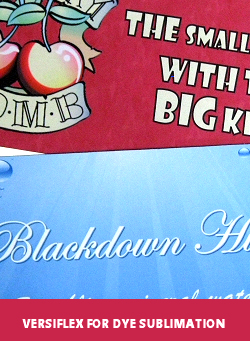
VersiFlex printing is a new process developed by sublimation market leaders Sawgrass and which will replace the now discontinued Chromablast process for printing on cotton.
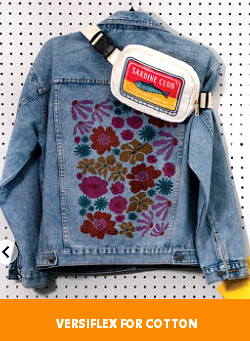
The one advantage of VersiFlex over sublimation is that it enables printing onto cotton, leather, wood and a range of uncoated products BUT you can also run sublimation paper through your VersiFlex printer and use it as a standard sublimation printer! The process itself is straightforward – VersiFlex ink is applied to a specially coated transfer paper using a modified inkjet printer with special colour balancing software – the transfer is then applied firmly to the imprintable item and heat applied (either via a heat press or for some items in an oven) – the ink transfers to the imprintable item – giving a “photo quality” image. The one drawback is that because of the different nature of the process the print is slightly less durable so for example ceramic mugs are not dishwasher safe and printed shirts will only survive around 20 washes – but if you need a lasting image just turn your VersiFlex printer into a sublimation printer by using the appropriate paper and sublimation imprintables.
The cost per VersiFlex print is higher than the sublimation equivalent – but because of the wide range of cheap imprintables (cotton T’s, uncoated wood, etc) then the overall cost per finished item is similar. 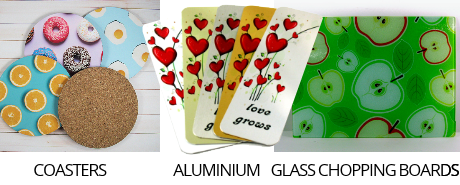 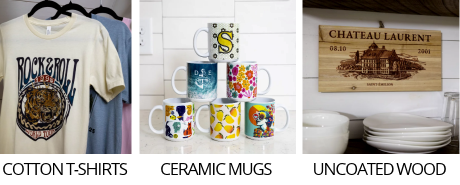  | ||||||||||||||